A matching wedding band should look as if it was always meant to sit beside the engagement ring. When it works, the two read as one design. When it doesn’t, you get an awkward gap, rings that rub, or a band that spins out of line all day.
The good news is that most problems are predictable. They come down to four things: the shape of the engagement ring, the metal, the width and the fit. Get those right and the pairing looks effortless.
This guide walks you through each decision, with guide prices and a simple table to match your ring to the right band.
Start with the engagement ring
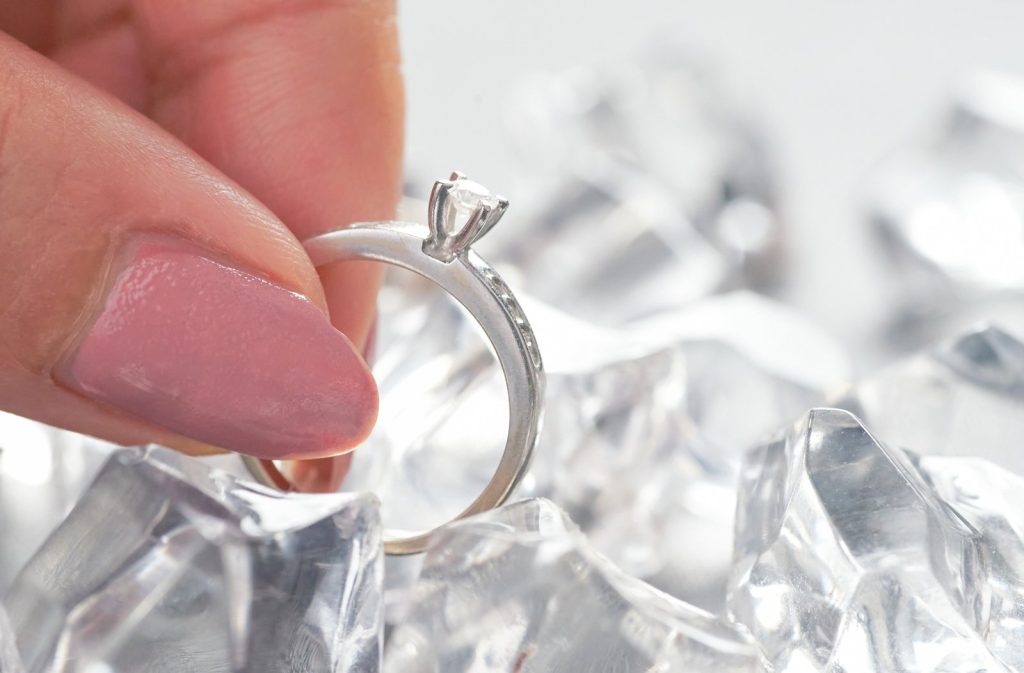
Before you look at a single band, look closely at the engagement ring from the side. The height of the setting decides almost everything. If the gallery sits high above the band, a straight wedding band can slide underneath and sit flush.
If the setting sits low, or a halo or wide head overhangs the band, a straight band will leave a gap. That gap is not a fault, but you should choose it deliberately. Otherwise, a shaped band is the answer.
Next, check four details, because each one changes which matching wedding band will work:
- Height: does the head sit high or low above the finger?
- Head width: does a halo or side stone overhang the shank?
- Shoulders: are they plain metal or set with diamonds?
- Shank width and profile: how wide and how thick is the band?
Our engagement ring buying guide explains how settings are built, if you are still choosing the engagement ring itself.
Matching wedding band shapes explained
There are five main shapes to know. Each solves a different problem, so it helps to see them side by side.
Straight band
The classic. A straight band sits neatly beside solitaires, bezels and higher settings. It is also the easiest to resize later and the most timeless.
Curved or contoured band
This band dips to follow the outline of the engagement ring’s head. It suits halos, three-stone rings and low-set ovals or pears, because it closes the gap without fighting the setting.
Wishbone or chevron band
A pointed curve that rises to a V. It pairs beautifully with pear, marquise and oval stones, and it can make a slender finger look longer.
Notched band
A straight band with a small notch cut out where the engagement ring’s head sits. It keeps the clean look of a straight band while letting the two rings sit closer.
Bespoke fitted band
Made around your actual engagement ring, so it follows every curve. It is the best answer for unusual, vintage or antique rings that no ready-made band will fit.
Which matching wedding band suits your ring?
Here is a quick way to match your ring to the right wedding band. Treat it as a starting point, then try the combination on.
| Your engagement ring | Band that usually works | Why |
|---|---|---|
| Low-set solitaire or bezel | Straight plain or half eternity band | Sits flush with no gap |
| High cathedral solitaire | Straight band | The band slides under the gallery |
| Halo, low gallery | Curved, notched or fitted band | The halo overhangs a straight band |
| Three-stone ring | Contoured band, or a straight band with a planned gap | The head is wide across the finger |
| Pear, marquise or oval | Wishbone or chevron band | The curve follows the stone’s point |
| Vintage or antique ring | Bespoke fitted band | Irregular shapes need a custom fit |
Flush fit or a small gap?
A flush fit means the two rings touch along their whole length. It looks seamless, but it needs either a high setting or a shaped band. A small, even gap, in contrast, can look clean and intentional, especially with a halo and a slim straight band.
What matters is that the choice looks deliberate. A gap that varies, or a band that tilts to fill it, never looks right.
Some couples have the two rings soldered together after the wedding. This stops them rubbing and keeps them perfectly aligned. However, they can then only be worn together, and both rings must be resized as one, so think carefully first.
Choosing the metal: match, mix or contrast
For a seamless matching wedding band, use the same metal and carat as the engagement ring. Two different metals rubbing together wear at different rates, so the softer one gradually loses metal. Matching them avoids that and keeps the colours identical.
Colour is the other reason. Most white gold is plated with rhodium for a bright white finish, and over time that plating can wear to show a warmer tone.
Platinum, meanwhile, is naturally white throughout. So a white gold band beside a platinum engagement ring can look mismatched within a year or two.
Mixing metals on purpose can look wonderful, for example a yellow gold band beside a platinum ring. If you do, choose metals of similar durability, such as 18ct gold with platinum, rather than a soft 9ct band beside a hard platinum ring.
We work only in solid, hallmarked 9ct, 14ct and 18ct gold and 950 platinum, and our alloys are nickel-free, which matters for sensitive skin. Every piece is independently hallmarked in the UK; the Goldsmiths’ Company Assay Office explains what each mark means. Our guide to gold carats and platinum compares the options in detail, and you can read more on our materials page.
Choosing your partner’s matching wedding band
Your two bands don’t need to be identical to belong together. Many couples link them through the same metal, the same finish or a shared detail, such as a milgrain edge. That way, each band suits its wearer while the pair still feels like a set.
Wider bands, often around 4 to 6 mm, are popular for a partner who wears a single ring. A comfortable court profile helps a wider band feel natural from the first day.
Bring your engagement ring, leave with a plan
We can design a band around your ring and show it to you in 3D before any metal is cut. Call 0 7450 483 941 to book a private appointment in Hatton Garden or a video call.
Width, profile and comfort
Width is about proportion. Most women’s bands worn beside an engagement ring are between 2 and 3 mm wide. As a rule, match the wedding band to the width of the engagement ring’s shank, and the pair will look balanced.
Profile is the shape of the band in cross-section. These are the four you will hear most often:
- Court: rounded inside and out, very comfortable and the most popular.
- D-shape: flat inside, rounded outside; a classic, traditional look.
- Flat: flat inside and out, crisp and modern, but it can feel tighter.
- Flat court: flat outside, rounded inside, combining a modern look with comfort.
Depth matters too. A very thin band can bend or wear through over the decades, so ask how deep the metal is, not just how wide. For daily wear, a band that is too delicate is a false economy.

Diamond bands: half eternity, full eternity and pavé
A diamond-set matching wedding band adds sparkle and can tie in with pavé shoulders. A half eternity band has diamonds across the top only, so it can usually be resized a little. A full eternity band has stones all the way round, which looks spectacular but is very difficult to resize.
There is one practical warning. Diamonds can scratch diamonds, and two stone-set bands rubbing together can loosen stones or wear down the tiny beads that hold them. A plain band between two diamond bands, or a slight separation built into the design, prevents that.
Whatever you choose, diamond bands need regular checks. We invite clients to visit once a year for a complimentary clean and claw check, which catches loose stones before they are lost.
Sizing and timing: when to order
Usually, the wedding band is made in the same size as the engagement ring. However, two rings worn together can feel slightly tighter than one, and wider bands often need about half a size more. Always try the pair on together before you finalise the size.
Timing matters more than most couples expect. Start looking around three months before the wedding, so there is room for any adjustments. Bespoke bands are delivered 4–6 weeks after you approve the design, and every design is 3D-modelled so you see it first.
Bring the engagement ring to your appointment. A band shaped by eye from a photograph is never as good as one fitted against the real ring.
Engraving and finishing touches
An engraved date, initials or a few private words inside the band make a matching wedding band entirely yours. Keep inside engraving short on slim bands, because there is only so much room.
Finish is worth a thought too. A polished band matches most engagement rings, while a brushed or satin finish looks softer but will gradually polish itself with wear. Either can be refreshed by a jeweller in years to come.
Finding a matching wedding band in Hatton Garden
Hatton Garden has been London’s jewellery quarter for generations, and it remains the best place to see many band shapes side by side. It is easy to reach if you are comparing engagement rings in Islington or looking at engagement rings in Clerkenwell, just a few minutes away.
You can also see all the areas we serve. If you would like to commission something unique, our guide to commissioning a bespoke ring in Hatton Garden explains each step.
Quick answers
Does a wedding band have to match the engagement ring?
No, but it helps if the metal matches. A mismatched metal can wear the other ring and may look different in colour over time. Style, by contrast, can contrast happily.
Should a matching wedding band be the same size as the engagement ring?
Usually, yes. That said, a wide band may need about half a size larger, and the two rings can feel tighter together, so try them on as a pair.
Can I wear a gold band with a platinum engagement ring?
Yes, and it can look striking. Choose 18ct gold rather than 9ct, so the two metals wear at a more similar rate, and expect them to rub slightly over time.
Which order should the rings go on?
Traditionally in the UK, the wedding band sits closest to the hand, with the engagement ring on top. Many people simply wear whichever order looks and feels best.
How far ahead should we order a matching wedding band?
Around three months before the wedding is ideal. That leaves time for a bespoke design, which is delivered 4–6 weeks after approval, plus any final adjustments.
Matching wedding band: the short version
Start with the engagement ring’s height and head, then choose a straight, curved, wishbone, notched or fitted band to suit it. Match the metal and carat, keep the widths in proportion and try the pair on together before you commit.
Above all, bring the engagement ring with you. The perfect band is the one shaped around the ring she already loves.
A band made to sit perfectly
Bespoke bands are delivered 4–6 weeks after you approve the design, in solid, hallmarked gold or 950 platinum. Call 0 7450 483 941 or email hello@hattondiamond.co.uk to start.