Moissanite vs diamond is one of the most searched questions in engagement rings, and white sapphire often joins the debate. All three are colourless, hard enough for daily wear and beautiful in their own way. Yet they look, behave and hold value very differently.
We work in natural and laboratory-grown diamonds, so we have a view. However, this guide is written to be fair to all three stones. You will find the real numbers, the honest trade-offs and the questions worth asking any jeweller.
Our aim is simple: whichever stone you choose, choose it knowingly.
Three white stones in one minute
A diamond is pure carbon, crystallised under enormous heat and pressure. It can be natural, formed deep in the earth over billions of years, or laboratory-grown, made in weeks with the same chemistry and crystal structure. Both are real diamonds.
Moissanite is silicon carbide. It is named after the French chemist Henri Moissan, who found tiny crystals of it in 1893 in fragments of a meteorite from Arizona. Natural moissanite is extremely rare, so virtually all moissanite in jewellery is made in a laboratory.
White sapphire is colourless corundum, the same mineral as blue sapphire and ruby. It can be natural or lab-grown, and lab-grown corundum has existed since the early twentieth century.
Moissanite vs diamond: the properties side by side
The table below compares moissanite vs diamond, with white sapphire alongside, on the things that matter most. Prices are typical UK retail guides for a loose stone with the look of a 1ct round, around 6.5 mm across.
| Property | Diamond | Moissanite | White sapphire |
|---|---|---|---|
| What it is | Carbon | Silicon carbide | Colourless corundum |
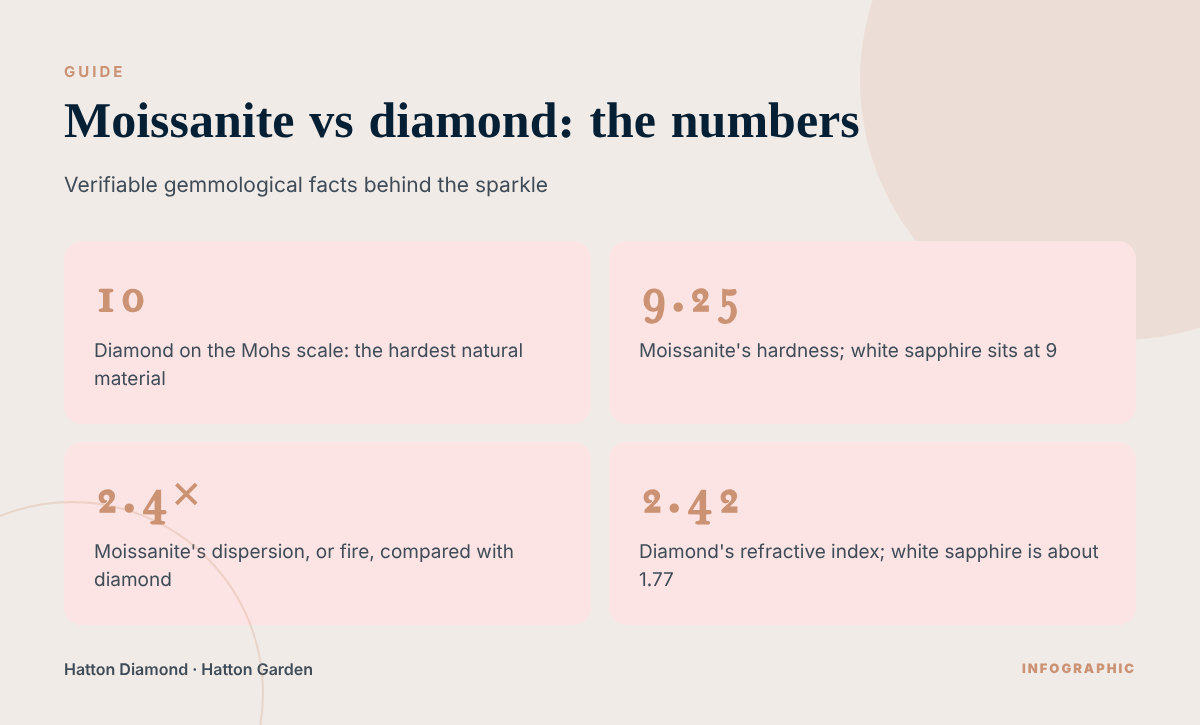
| Hardness (Mohs) | 10 | 9.25 | 9 |
| Refractive index | 2.42 | About 2.65–2.69 | About 1.76–1.77 |
| Dispersion (“fire”) | 0.044 | About 0.104 | About 0.018 |
| Refraction | Single | Double: facet edges can look doubled | Double, but too weak to see |
| Typical price, 1ct look | Natural: £4,000–£9,000; lab-grown: £500–£1,500 | £250–£700 | £100–£600 |
| Typical resale value | Natural: some; lab-grown: low | Very low | Very low |
Guide prices only. Diamond prices depend heavily on cut, colour and clarity, as our guide to what a diamond actually costs explains.
Sparkle: brilliance, fire and the “disco ball” question
Sparkle has two parts. Brilliance is the white light a stone returns, and fire is the flash of rainbow colour. Diamond balances the two, which gives it the crisp, bright look most people picture.
Moissanite has a higher refractive index and more than twice diamond’s fire. As a result, it throws strong rainbow flashes, especially in sunlight. Some people love that intensity, while others find it reads as “not quite diamond” from across a room.
White sapphire sits at the other end. Its lower refractive index means less brilliance and very little fire, so it looks softer and more glassy. It also shows a film of grease quickly, so it can look dull between cleans.
In every case, cut quality matters enormously. A beautifully cut white sapphire can outshine a poorly cut stone of any kind.
Moissanite vs diamond in different light
Lighting changes the comparison more than most people expect. In candlelight or a dim restaurant, the two can look surprisingly similar. In direct sunlight, however, moissanite’s rainbow fire is far stronger, and that is the moment most people notice the difference.
Under bright office lighting, a well-cut diamond tends to look whiter and crisper, while moissanite looks more colourful. Neither is wrong; they are simply different personalities.
Durability and everyday wear
All three stones are hard enough for an engagement ring. On hardness, moissanite vs diamond is closer than many expect: diamond is the hardest natural material, at 10 on the Mohs scale. Moissanite follows at 9.25, and sapphire sits at 9.
Hardness is not the whole story, however. Diamond can still chip if it is struck hard on an edge or point, because it has natural planes of weakness. Moissanite is tough and resists heat well, while sapphire is also tough but can show tiny abrasions on facet edges after many years of knocks.
Colour stability is worth a mention too. Early moissanite often showed a faint yellow or green tint. Modern colourless grades are much improved, although some stones can still show a hint of warmth in larger sizes or certain lights.
Cleaning and care
All three stones can be cleaned at home with warm water, a drop of washing-up liquid and a soft toothbrush. White sapphire needs it most often, because grease dulls it fastest. Our guide to cleaning and caring for fine jewellery covers the safe methods step by step.
Whichever stone you choose, the setting matters more than the gem. That is why we invite clients to visit once a year for a complimentary clean and claw check.
How to tell them apart
Under a loupe, the moissanite vs diamond question is usually settled by double refraction. Look through the top of the stone at an angle, and the facet edges behind can appear doubled. A diamond never shows this.
Basic thermal diamond testers can mistake moissanite for diamond, because both conduct heat very well. That is why jewellers use testers that also measure electrical conductivity. White sapphire, by contrast, fails a thermal test straight away.
Laboratory-grown diamond is a different case. It is diamond, so it passes every diamond tester, and only gem laboratories can confirm its origin. For reference, the Gemological Institute of America publishes accessible research on how labs separate natural, laboratory-grown and simulant stones.
Our rule is short: no stone leaves here described as something it is not. When you visit, we put a ten-times loupe in your hand so you can see the differences for yourself.
See the difference under a loupe
We put a ten-times loupe in your hand and explain exactly what you are looking at. Call 0 7450 483 941 to book a private appointment in Hatton Garden or a video call.
Cost, value and resale: the honest picture
On price alone, moissanite vs diamond is no contest. Moissanite and white sapphire are the most affordable ways to get a large, white look. A moissanite with the face-up size of a 2ct diamond can cost less than a modest natural diamond, and for a tight budget that matters.
The equation has changed, however. Laboratory-grown diamond prices have fallen sharply in recent years, and in many sizes they now sit far closer to moissanite than they once did.
That gives buyers a diamond’s look and hardness for a fraction of a natural stone’s price. Our guide to natural and laboratory-grown diamonds compares the two in detail.
Resale is where the stones divide most clearly. Natural diamonds keep some resale value, although always well below the retail price. Lab-grown diamonds, moissanite and white sapphire have little resale value, so buy them to wear and love rather than as a store of value.
Insurance and valuations
Insurers base cover on a written valuation, so the stone must be described accurately. A moissanite valued as a diamond could lead to a dispute when you claim, while a vaguely described diamond could leave you under-insured. Ask for a valuation that names the stone, its weight or size and any report number.
Moissanite vs diamond vs white sapphire: which should you choose?
There is no wrong answer, only the right one for you. Here is a simple way to decide.
- Choose a natural diamond if rarity, heirloom value and some resale matter to you.
- Choose a laboratory-grown diamond if you want diamond’s look and hardness for less, and accept low resale.
- Choose moissanite if you love intense fire, want a larger look on a small budget and don’t mind it reading differently.
- Choose white sapphire if you prefer a softer, quieter look, or a vintage feel at the lowest cost.
- Consider a coloured sapphire if you would rather have a stone with its own identity than one that imitates a diamond.
That last option deserves a moment. A blue, teal or pink sapphire is as hard as a white one, but its colour makes it unmistakably itself. You can explore the colours on our sapphires page.
Five questions to ask any jeweller
Whatever you choose, these questions protect you. A good jeweller will answer every one happily, and in writing.
- Is this stone natural, laboratory-grown or a simulant, and will the receipt say so?
- Does it come with an independent report, and from which laboratory?
- Has it been treated in any way, and is that disclosed in writing?
- Is the metal solid and hallmarked, and what is the fineness?
- What happens if the ring needs resizing, cleaning or a claw check later?
For our part, treatments are disclosed in writing before you pay, and centre diamonds from 0.30ct come with an independent laboratory report. We use only solid, hallmarked gold and 950 platinum, and nothing is plated or filled.
Comparing stones in Hatton Garden
Reading about sparkle only goes so far. Seeing a diamond, a lab-grown diamond and a coloured gem in daylight, side by side, settles most debates in minutes. Hatton Garden has been London’s jewellery quarter for generations, and that kind of comparison is what the street does best.
It is an easy trip from engagement rings in King’s Cross or engagement rings in Barnsbury, and we also offer video appointments. You can see all the areas we serve on one page.
Quick answers
Moissanite vs diamond: can a jeweller tell them apart?
Yes. Under a loupe, moissanite shows doubled facet edges, and a tester that measures electrical conductivity will identify it. A basic thermal tester alone can be fooled, so ask which tester is being used.
Is moissanite a fake diamond?
It is a diamond simulant: a genuine gemstone in its own right, but not a diamond. Selling it honestly as moissanite is perfectly fine; selling it as diamond is not.
Does moissanite go cloudy?
Good-quality moissanite does not go cloudy by itself. Like any stone, it collects grease and soap film, which dulls the sparkle until it is cleaned.
Is white sapphire good for an engagement ring?
It is durable enough, at 9 on the Mohs scale. However, it has much less sparkle than diamond or moissanite and needs frequent cleaning to look its best.
Moissanite vs diamond: which holds its value better?
A natural diamond holds value best, although resale is always below retail. Moissanite, white sapphire and lab-grown diamond have little resale value.
Moissanite vs diamond: our honest verdict
Diamond offers the classic balance of brilliance and fire, the greatest hardness and, if natural, lasting rarity. Moissanite gives dazzling fire for less, and white sapphire a gentle, affordable glow. Each is a valid choice when it is sold honestly.
So decide what matters most to you: look, budget, durability or heritage. Then see the stones in person, in daylight, before you commit.
Honest advice, in writing
Natural or laboratory-grown, every diamond we sell is clearly labelled, and any treatment is disclosed in writing before you pay. Call 0 7450 483 941 or email hello@hattondiamond.co.uk.