Diamond guide10 min readHatton Garden
Cut is craftsmanship; shape is taste. It is the first decision to make and the only one where nobody — not us, not a report, not a price list — can tell you that you are wrong.
Two families, not ten shapes
Before the individual outlines, one distinction explains most of what you will see in a window. Brilliant cuts use triangular and kite-shaped facets arranged to throw light back at you in flashes — round, oval, pear, marquise, cushion, princess, radiant and heart all belong here. Step cuts use long parallel facets arranged like a staircase, producing broad, calm flashes rather than sparkle — emerald and Asscher.
This matters commercially. A step cut has nowhere to hide an inclusion, so you need a higher clarity grade for the same visual result; it also shows colour more readily. Budget for one grade better on both if you fall for an emerald cut. In exchange you get the most architectural, least fussy stone in the case, and the one that photographs like nothing else.
The ten, and what each one does
| Shape | Classic ratio | Character |
|---|---|---|
| Round brilliant | 1.00 | Maximum light return, maximum price per carat, never looks dated |
| Oval | 1.35 – 1.45 | Lengthens the finger and faces up larger than a round of equal weight |
| Cushion | 1.00 – 1.15 | Soft corners, candlelit rather than crisp; forgiving of warmer colour |
| Princess | 1.00 | Square, modern, excellent value per carat; corners need protecting |
| Emerald | 1.40 – 1.50 | Long mirror flashes, glassy and calm; demands clarity |
| Asscher | 1.00 | Square step cut with a hall-of-mirrors depth; Art Deco at heart |
| Radiant | 1.20 – 1.35 | Emerald silhouette, brilliant fire — the compromise candidate |
| Pear | 1.50 – 1.60 | Elegant and elongating; the point must be protected by a V-claw |
| Marquise | 1.85 – 2.00 | Largest face-up area per carat of any shape |
| Heart | 0.95 – 1.05 | Unmistakable; needs 0.50ct or more before the cleft reads clearly |
All ten are drawn to scale, with their facet patterns, on the interactive diamond chart — select a shape and it appears full size beside its ratio and cutting style.
Matching the outline to the hand
This is the part of the conversation that happens across a counter, not on a website, but the principles are simple enough.
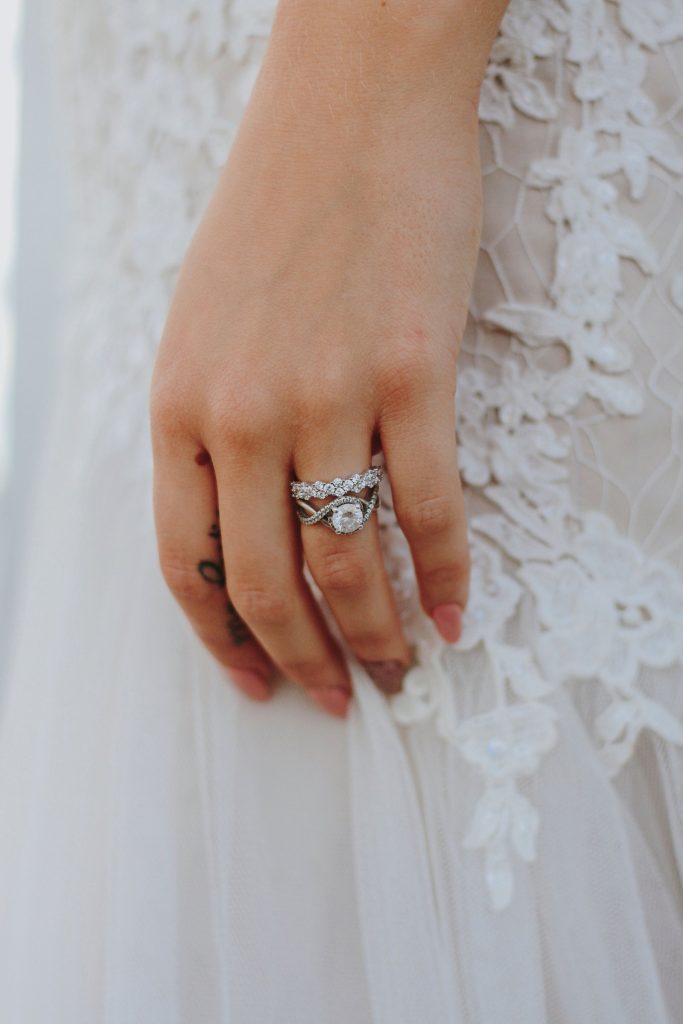
Shorter or wider fingers are flattered by anything elongated — oval, pear, marquise, emerald — set north to south. The eye reads the line of the stone as a continuation of the finger. Avoid very wide, low-set square shapes, which cut the finger crosswise.
Long, slim fingers can carry almost anything, and are the only hands on which a wide cushion or a broad radiant looks generous rather than heavy. A round brilliant on a long finger often wants a slightly larger stone than you expect to hold its own.
Small hands should beware the marquise. It has the largest face-up area per carat, which sounds like an advantage until a 1.50ct sits from knuckle to knuckle.
Working hands — and that includes anyone who lifts, climbs, gardens or types all day — are better served by shapes with no points or sharp corners: round, oval, cushion. A pear or a princess in a claw setting will find a doorframe eventually.
By appointment · Hatton Garden
Try five shapes at the same weight
It is the single most useful half hour in the whole process. We will set out the same carat weight in five outlines so you can see what the difference actually looks like on your hand rather than on a screen.
What the setting has to do about it
Shape and setting are one decision, not two. Pears and marquises need a V-claw over the point, because points are where diamonds chip. Princess cuts need corner claws for the same reason. Emerald and Asscher cuts are usually held by four corner claws or a rubover, and both suit a slightly heavier shank because the stone itself is architectural.
Ovals have one particular trap: the bow-tie, a dark band across the middle caused by the pavilion shadowing itself. Every oval has one; on a well-cut stone it is faint and moves as the hand moves, and on a badly cut one it sits there like a stain. No report grades it. You have to look, in daylight, which is why we keep a north-facing window free on Hatton Garden.
Shapes, and what they cost
Round brilliants command the highest price per carat, for two reasons: they waste the most rough in cutting, and demand is relentless. Everything else is, in the trade’s language, a fancy shape, and fancy shapes typically run fifteen to thirty per cent below a round of equivalent grades.
If your budget is fixed and you want visible size, an oval or a cushion will buy you noticeably more stone than a round. If you want the piece to look exactly as it would have looked in 1955 and in 2095, buy the round.
Our short answer
Choose the shape you keep coming back to, then let us find the best-cut example of it inside your budget. A well-cut oval beats a mediocre round every day of the week, and the person wearing it will never once wish they had bought the other outline.
By appointment · Hatton Garden
Bring a photograph of the hand
Sounds odd; works beautifully. Proportion is everything with shape, and half the decision is made before you arrive. Book an appointment and we will do the rest with real stones.
Written on Hatton Garden. Grading terminology follows GIA definitions; prices are indicative at the time of writing and move with the market. Nothing here is a valuation.